A roll of bandage triggered panic: the trauma of domestic abuse can surface at work
23.09.2026
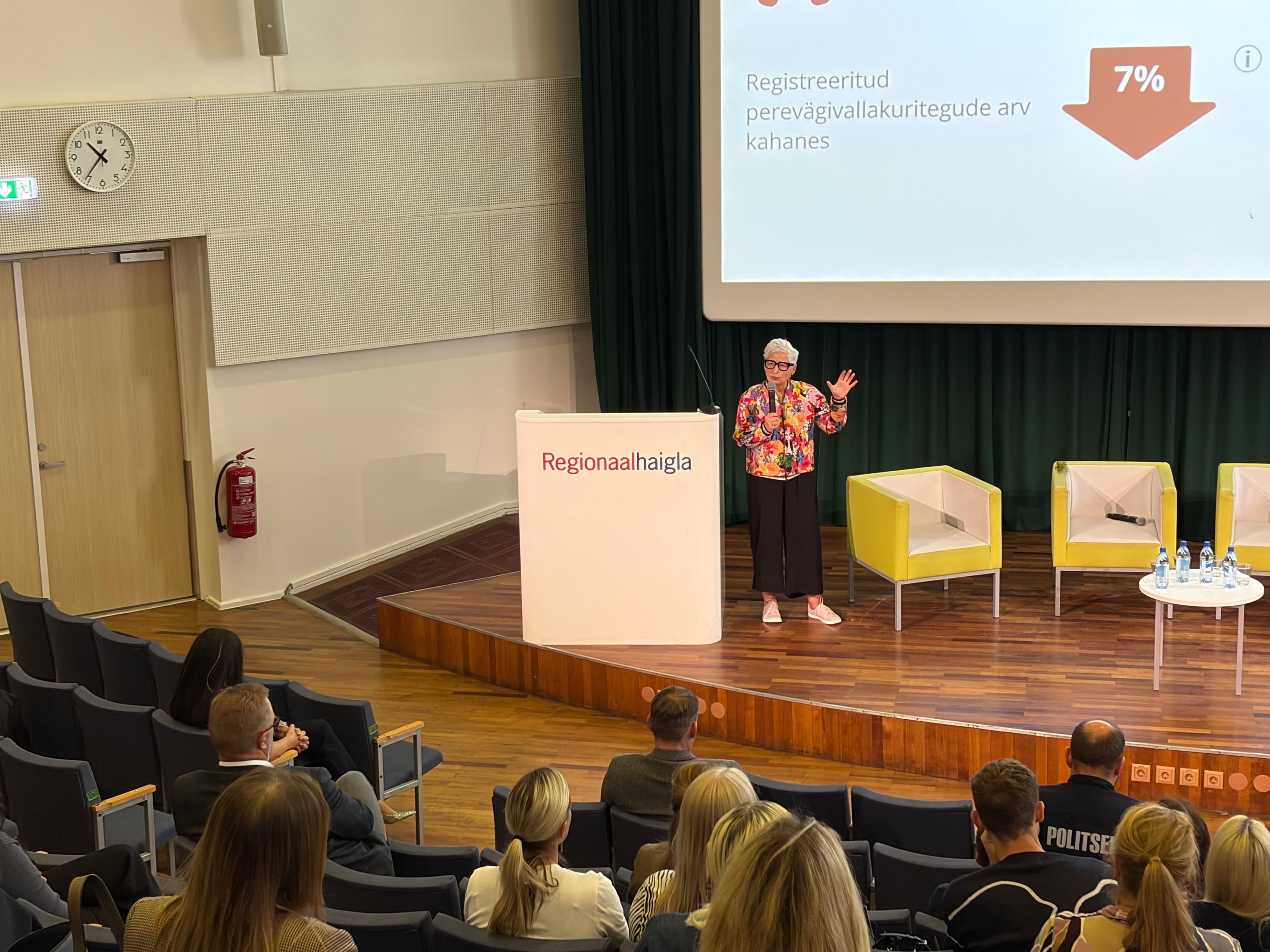
An employee’s unexpected reaction to a situation at work may have little to do with the situation itself. Sometimes, an entirely ordinary object, touch or situation can trigger trauma linked to past domestic abuse. “An employer does not need to be a therapist or an expert in domestic abuse, but they can be attentive and create a working environment where an employee is not left alone with their reaction,” says Margo Orupõld, head of the Pärnu Women’s Support Centre.
An accident occurred at a company. An employee fell and needed help to stop the bleeding. When another colleague who was present saw a roll of bandage, she began screaming hysterically. No one could understand why.
“The employee’s former partner had brutally beaten her years earlier,” recalled Margo Orupõld, who has worked with victims of domestic abuse at the Pärnu Women’s Support Centre for eighteen years. “He beat her so badly that afterwards she needed stitches or bandaging. The man would often treat the injuries himself, using rolls of bandage from his medical kit.”
Orupõld explained that although years had passed since the abuse, seeing the same kind of bandage being used on her colleague triggered the woman’s past trauma. “We never know what might trigger something in another person. In the context of trauma, this is what we call a trigger – and it is one of the reasons why domestic abuse is also an issue for employers.”
The workplace may be safe, but almost anything can become a trigger
Trauma does not remain in the past simply because years have passed since an abusive relationship ended. In certain situations, a physical and emotional response connected to an earlier experience can be triggered, and often the person is unable to control it because it happens almost automatically.
“A trigger activates a traumatic memory and, with it, the physical sensations and emotions associated with the earlier trauma,” Orupõld explained. Almost anything can become a trigger: a sentence, smell, word, voice, look, music, touch, environment, person, situation, question, object or substance. This means that triggers can also occur at work, and colleagues will usually have no way of knowing why an entirely ordinary workplace situation has provoked such a strong reaction.
The statistics underline the scale of the issue. According to Estonia’s Ministry of Justice and Digital Affairs, 3,125 domestic violence offences were registered in Estonia in 2025. When stalking and breaches of restraining orders are included, a total of 3,305 offences committed within intimate relationships were recorded.
“Gender, nationality, education or financial status make no difference here. It can happen to anyone. Many of these women – and men too – go to work. They are colleagues who may come to work in the morning precisely because, for a while, it feels like a safe place to be, because the person behaving abusively is not there,” Orupõld said.
Real-life examples
The roll of bandage is not the only example of something seemingly harmless reopening old wounds. For another survivor of severe domestic abuse, the trigger was being hugged.
“She was sociable, friendly and helpful, so colleagues and clients often wanted to hug her,” Orupõld explained. “The woman went into shock every time someone put their arms around her, especially from behind.”
In a previous relationship, the woman had been strangled and subjected to degrading acts involving her body. Although she did not hate her body, she would not allow anyone to touch it.
The same pattern runs through all these stories: people did not ask, the victim did not speak, and colleagues gradually began to distance themselves. After her reaction to the roll of bandage, the woman was seen as “strange” by her colleagues. People withdrew from her, she became isolated and eventually left her job because of the lack of understanding within the team. The woman who froze when hugged was simply considered arrogant.
According to Orupõld, there is usually no malicious intent behind this. Rather, people often do not know how to respond to situations like these – either at work or in everyday life.
“Everyone feels a little embarrassed or awkward, and instead of finding a safe moment to ask whether the person is all right, they keep their distance. Often, the same pattern is then repeated in a new workplace, and then the next one, until eventually the person is left alone with an extremely difficult situation.”
Another telling example involves a hotel employee from a few years ago. She was a capable and well-liked colleague who was always willing to work overtime and cover other people’s shifts. Her employer did not understand why she was doing this until her work began falling behind schedule and she was found crying in an uncleaned hotel room. Feeling that she was in a safe environment, the woman finally spoke about what was happening to her.
According to Orupõld, being excessively conscientious or accommodating can itself be a sign worth noticing. “When we think about victims of domestic abuse, they will usually tell you that everything is absolutely fine. On the surface, they never seem to have any problems, but in reality, the phrase ‘I’m fine’ may simply be a learned, automatic response.”
Employers do not need to be experts in domestic abuse
Drawing on her many years of experience in the field, Margo Orupõld says employers should understand how trauma can affect an employee’s behaviour and practise trauma-informed leadership. Above all, this means being attentive and approaching unexpected reactions or changes in behaviour with non-judgemental curiosity.
First, changes in behaviour deserve a question. If a previously friendly colleague suddenly becomes withdrawn or reacts unexpectedly strongly to an ordinary gift, gesture or workplace situation, it may be worth seeing this as a possible sign.
“The victim will not usually come and tell you themselves – fear, shame or the habit of staying silent can be incredibly powerful – but at the same time, they are waiting for someone to ask. It is difficult, but this is something we have to learn to do,” Orupõld stressed.
According to Orupõld, most of the signs colleagues might notice are not unusual in themselves. Trauma can manifest physically through anxiety and restlessness, such as pacing or wringing one’s hands, but also through pain, headaches or stomach aches, disordered eating or dizziness. At the other extreme, a person may become numb and passive, seemingly unaware of what is happening around them. The emotional layer can be harder to notice: anxiety, panic, confusion, memory gaps, impaired ability to think, feelings of guilt and a distorted sense of time.
Second, the workplace is often one of the few places in a victim’s life where they are not under the supervision of the person behaving abusively. This gives employers and colleagues a particularly important role in maintaining a stable, predictable and non-judgemental environment. The case of the hotel employee is a good example: she was ultimately able to share what was happening to her because she felt safe.
“An employer does not need to be a domestic abuse specialist,” Orupõld said. “We do not have to be experts in everything. If something goes wrong at home, we call a plumber, for example.”
On one occasion, an employer called the support centre directly and simply said: “I don’t know what to do.” According to Orupõld, that was the essential first step.
The head of the Women’s Support Centre gives several other examples of how a small and practical action by an employer can sometimes have a greater impact than a major intervention. In one case, an employer allowed an employee to sleep at the workplace overnight rather than sending her home. In another, a simple question such as “When did you last eat?” was, according to Orupõld, the first real form of help the person received. Victims often do not think about eating because all their resources are focused on assessing and managing danger.
There have also been cases where an employer’s role has been much more direct. In one instance, an employer documented signs of physical abuse and worked with the police because the victim was not yet ready to make a formal report.
Orupõld estimates that around 30 per cent of employers in the area where she works are already aware and attentive, which she considers a very positive figure. The question, she says, is not so much whether employers notice the signs, but whether they know what to do once they have noticed them.
“One of the simplest things any employer can do is simply know where to turn if they suspect domestic abuse,” Orupõld emphasised. Options include the Victim Support Crisis Helpline, local women’s support centres and Employers Against Domestic Abuse, an initiative aimed at employers that brings together information and resources for victims, people close to them and employers. “That way, we can avoid a situation where the first response is delayed simply because people do not know what to do.”
This article is based on Margo Orupõld’s presentation at the September network meeting of Vägivallavabaks, an initiative aimed at employers.